Give your business a brain: why all your data needs to live in one place before AI can help
You have the data. It is spread across seven tools that have never met. Until it lives in one place, neither you nor AI can see what is actually working.

Richard Mawer
Founder, Leadnamic Systems Ltd
You have the data. It is in your accounts package, your CRM, your email tool, your website analytics, your project tracker, and a handful of spreadsheets. What you do not have is the answer to a simple question: what is actually working?
The reason is not that you lack information. It is that your information lives in seven places that have never met. Every tool knows its own corner of the business and nothing else. So when you ask which marketing produced the customers who paid on time and bought again, no single tool can tell you, because no single tool holds all three facts.
The answer is a central data layer. One place where every source lands, side by side, so the whole business can be seen at once. Build that, and AI finally has something worth analysing. Skip it, and AI is guessing from fragments, the same as you are.
Why can't you just get a dashboard?
I meet so many business owners who ask for a dashboard first. I understand why. A dashboard feels like clarity. You can see it, show it to the team, and put it on a screen in the office.
The reality is that a dashboard is only a window. It can only show what sits behind it. If the sales data is in one system and the finance data is in another, the dashboard either shows one of them or someone spends every Monday morning copying numbers into a spreadsheet to join them up. That spreadsheet is the data layer, built by hand, and it is wrong by Tuesday.
You cannot have the dashboard before you have the data. The order matters. Sources first, then the layer that joins them, then the view on top.
Where does your business data actually live?
Think about this for a moment. Walk through the tools you pay for and what each one knows that the others do not.
Your accounts package knows what was invoiced, what was paid, when it was paid, and what it cost you. It knows your margin by job and your cash position. It knows nothing about where the customer came from or how long they took to close.
Your CRM knows every conversation. Who enquired, when, what they asked for, which stage the deal reached, who owns it, and what was said on the last call. It is the single source of truth for activity and relationships. It does not know whether the invoice was paid or what the job actually cost to deliver.
Your email marketing tool knows who opened what, who clicked, who unsubscribed, and which campaign drove a reply. It does not know whether any of those clicks became revenue.
Your website analytics know where visitors came from, what they read, and where they left. They do not know which visitor became an enquiry, let alone a customer.
Your project or job management tool knows how long delivery took, who did the work, where it overran, and whether the client was chased for information. It does not know what the job was sold for.
Your support desk knows which customers raise tickets, how often, about what, and how quickly they were resolved. It does not know whether those customers renewed.
Your spreadsheets know whatever someone remembered to type into them.
Every one of these is useful on its own. None of them can answer the questions that grow a business, because those questions always cross at least two of them. Which lead source produces customers who pay on time? Which service line has the best margin after delivery overruns? Which customers who raise a lot of tickets then leave, and could you have seen it coming?
What is a central data layer?
A central data layer is a place where all of those sources are copied into one structure, refreshed on a schedule, and joined on the things they share: the customer, the job, the date, the person who handled it.
It is not another tool your team has to use. Nobody types into it. It sits behind everything, pulling from each system automatically, so the CRM stays the place for conversations, the accounts package stays the place for money, and the data layer is the place where they are seen together.
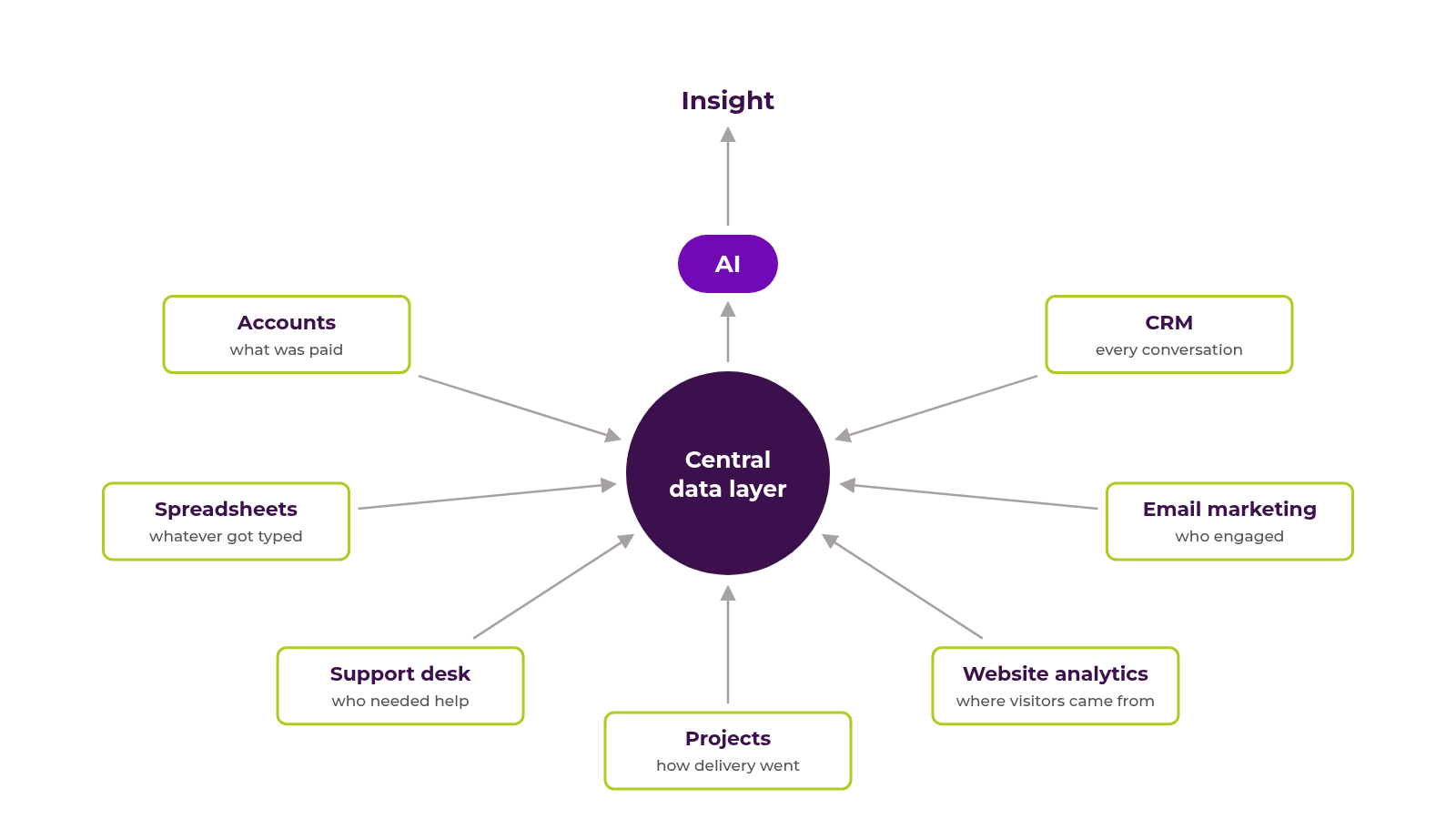
In my first book I said the CRM should be your single source of truth, and for conversations and activity it still is. What has changed is that the CRM is now one input among seven. The single source of truth for the business as a whole is the data layer that all seven feed into. That is the shift, and it is the one most small businesses have not yet made.
Here's what I mean. A client of mine, a packaging manufacturer with a £4 million turnover, had run for thirty years on sticky notes and spreadsheets. When we put a CRM in and connected it to what they already had, the managing director told me it was the first time in ten years he actually knew what was in his pipeline. That was one source connected. The real change comes when all of them are.
How do you build one?
The principle is simple. Connect, do not retype. Every source already holds its data in a structured form, and modern business intelligence tools can pull from them directly without anyone exporting a file.
In my own consultancy we use Zoho Analytics as the data layer. It connects to the CRM, the accounts package, the email tool, website analytics, and the support desk, and it refreshes on its own. The tool is not the point. The point is that a single business intelligence layer with ready-made connectors to the tools you already run now costs a small business tens of pounds a month, not tens of thousands, and it does in an afternoon what used to need a developer. Any tool that connects to your sources and joins them will do the job. The one you choose matters far less than doing it at all.
Once the layer exists, the dashboard takes an hour. And something far more useful becomes possible.
Where does AI come in?
This is the part that gives your business a brain.
AI is only as good as what it can see. Ask it about your sales pipeline and it can tell you about the pipeline. Ask it about your business and, if your data is in seven places, it can tell you nothing, because it is looking at one fragment.
Point it at the central data layer and the picture changes. Now it can look across every source at once and do the analysis no person has time for. It can tell you that customers from one lead source take twice as long to pay. That jobs sold by one person overrun delivery far more often than jobs sold by another. That the customers who left last year all raised three or more support tickets in the six months before, and five current customers fit the same pattern today.
None of those are things you could have seen by looking at any single tool. All of them are things you can act on this week.
I have seen this with clients time and again. One had spent £10,000 on paid search for a single lead. Nobody had noticed because the ad spend sat in one place and the leads sat in another. The moment the two were side by side, the number was obvious and the money stopped. That is what a data layer does. It makes the obvious visible.
What should you do first?
Be honest with yourself. List every tool that holds business data, including the spreadsheets. Next to each one, write the one question you wish it could answer but cannot, because the answer needs data from somewhere else.
That list is your case for a data layer, and it is usually about six lines long.
Then pick the two sources whose join would answer the most expensive question. For most businesses that is the CRM and the accounts package, because together they show what you sold, what it cost, and whether you got paid. Connect those two first. Build the rest from there.
If you want to see how the whole business measures up, the Clarity Scorecard takes five minutes and shows where your data is scattered and what to connect first.