The leaky bucket: why your business does not have a lead problem
You are getting enquiries, but the business is not growing the way they say it should. The problem is not leads. It is the leaks between the enquiry arriving and the money landing.

Richard Mawer
Founder, Leadnamic Systems Ltd
You are getting enquiries. The phone rings, the website form fills, people find you on LinkedIn. And the business is still not growing the way the enquiries say it should.
If that is you, the chances are you do not have a lead problem. You have a leak. Somewhere between the enquiry arriving and the money landing, opportunities are quietly draining out of your business. Nobody notices, because nobody is watching that part. Everyone is watching the top, where the new leads come in.
I meet so many business owners who are spending money on more leads while losing the ones they already have. This post is about where the leaks are, what they cost, and the one thing to do first.
Why does more marketing not fix it?
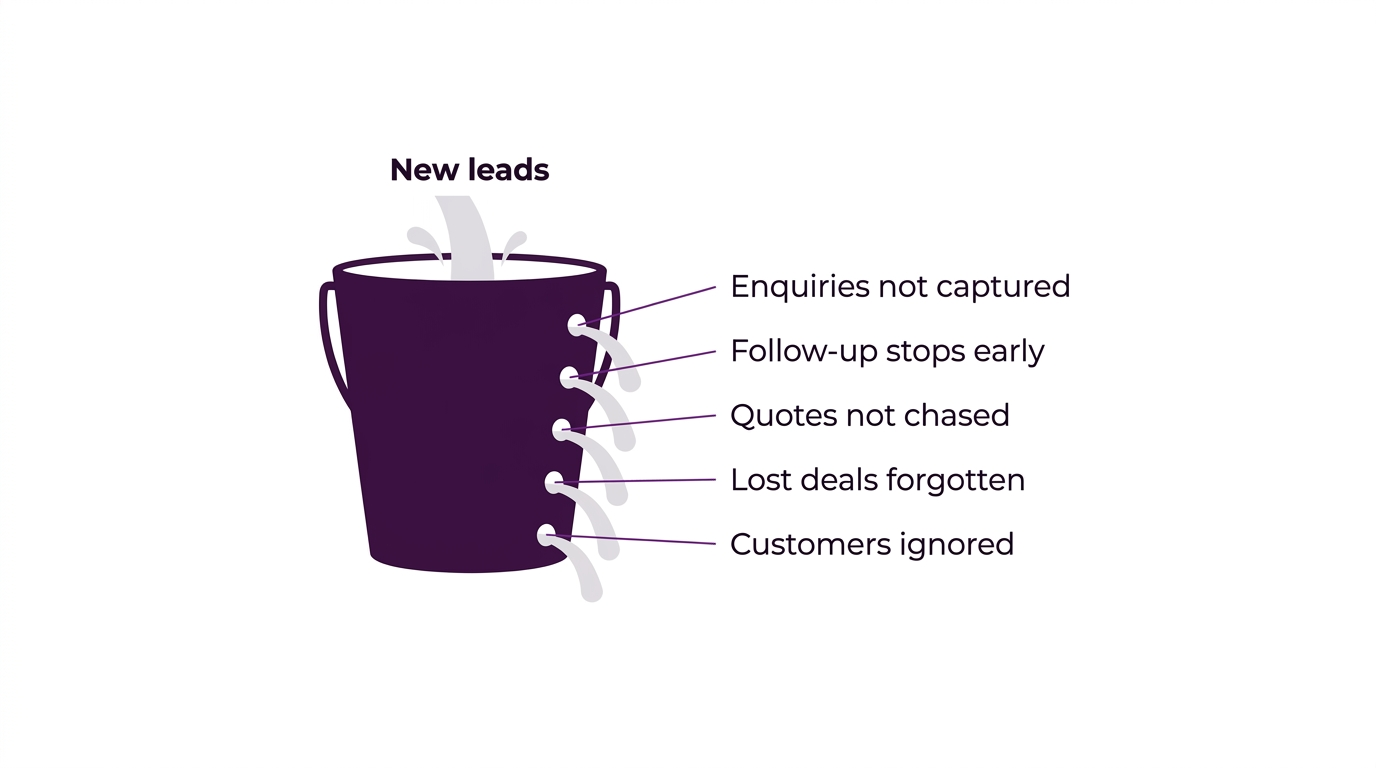
Think about this for a moment. Picture a bucket with holes in it. You can keep pouring water in, faster and faster, and the level never rises. That is most small businesses and their sales pipeline.
Leads come in at the top. Then a follow-up gets missed because Tuesday was chaos. A quote goes out and nobody chases it. Someone who enquired in March and was not ready is never contacted again. A customer who bought last year has not heard from you since. Each one is a hole.
The instinct when the bucket is not filling is to pour harder. More ads, more networking, another agency. The reality is that pouring harder into a leaking bucket is the most expensive thing you can do in a small business, because every new lead you pay for leaks out at the same rate as the last one.
Let's be honest. This is not a failure of effort. You are busy, your team is small, and follow-up relies on someone remembering. That is the actual problem. Anything in your business that relies on someone remembering is a hole.
Where are the five biggest leaks?
I have seen this with clients time and again, and the same five holes appear in nearly every business I look at.
The first is enquiries that never get captured. Website visitors, web chat conversations, calls taken on a mobile in the van. They happen, and then they are gone, because there was no system to catch them.
The second is the follow-up that stops too early. One email, one call, then silence. The owner tells me, if they are interested they will come back to me. They will not. They are as busy as you are.
The third is the quote or proposal that is never chased. You did the work of winning the conversation, you wrote the document, you sent it, and then you went back to generating new leads while it sat in someone's inbox.
The fourth is the deal you lost and never spoke to again. Closed lost is treated as the end. It is not the end. Their situation changes, the supplier they chose lets them down, their budget comes back. Nobody is there when it does.
The fifth is the existing customer you forgot about. You worked hard to win them, they spent money with you, and then they heard nothing. No check-in, no offer of the other things you do, no request for a referral.
Be honest with yourself. How many of those five are happening in your business this week?
What does one plugged leak actually look like?
Here's what I mean. In my digital agency, Digital Media Edge, we set up one process. Every deal we did not win was added to a follow-up sequence the moment it was marked as lost. An email went out at intervals, a friendly check-in asking how they were getting on and whether they had solved the problem we had talked about. No pitch, no pressure.
That one process brought back around 20% of the deals we had lost. It was worth over £100,000 a year to the agency. From a single automated follow-up that nobody had to remember to do.
We did not generate a single new lead to get that revenue. It was already in the bucket. We just stopped it leaking out.
What should you do first?
The principle is simple. Fix the leaks before you build the lead generation machine. Everything else in your sales and marketing follows from this. Put the volume in first and you are paying to lose leads faster.
The plugging does not need a person. It needs a process that triggers on its own. When a quote is sent, a reminder is created. When a deal is lost, a follow-up sequence starts. When a customer has not been contacted for ninety days, someone gets a task. These are rules, not judgement calls, which is exactly why a system should run them and a human should not.
In my own consultancy, these rules run inside the business operating system we built, so the follow-ups happen whether I am in the office or not. The tool matters far less than the rule. Any modern CRM with basic automation can do this.
So here is the action. Before you spend another pound on lead generation:
- List your last twenty enquiries and write next to each one what happened.
- List your last ten quotes and whether anyone chased them.
- List ten customers you have not spoken to in ninety days.
That list is your leak report. It will tell you more about why the business is not growing than any marketing plan.
If you want the full picture across your whole business, the Clarity Scorecard takes about five minutes and shows you where the biggest leaks are and what to fix first.