Your business needs an operating system, not more software
You are paying for more tools than ever and the business feels no clearer. The problem is not the tools. It is that nothing connects them.

Richard Mawer
Founder, Leadnamic Systems Ltd
You are paying for more tools than ever and the business feels no clearer than it did with a notebook and a phone. Every tool does its job. None of them talk to each other. And you are the one carrying information between them, in your head, all day.
If that sounds familiar, the problem is not the tools. It is that nothing connects them. Your business has plenty of software and no operating system.
An operating system, in a business, is the layer that joins every tool, moves information between them without anyone retyping it, and makes the next action happen on its own. Build that layer and the tools you already own start working as one. Skip it and the next tool you buy just adds another thing to carry.
What does an operating system actually do?
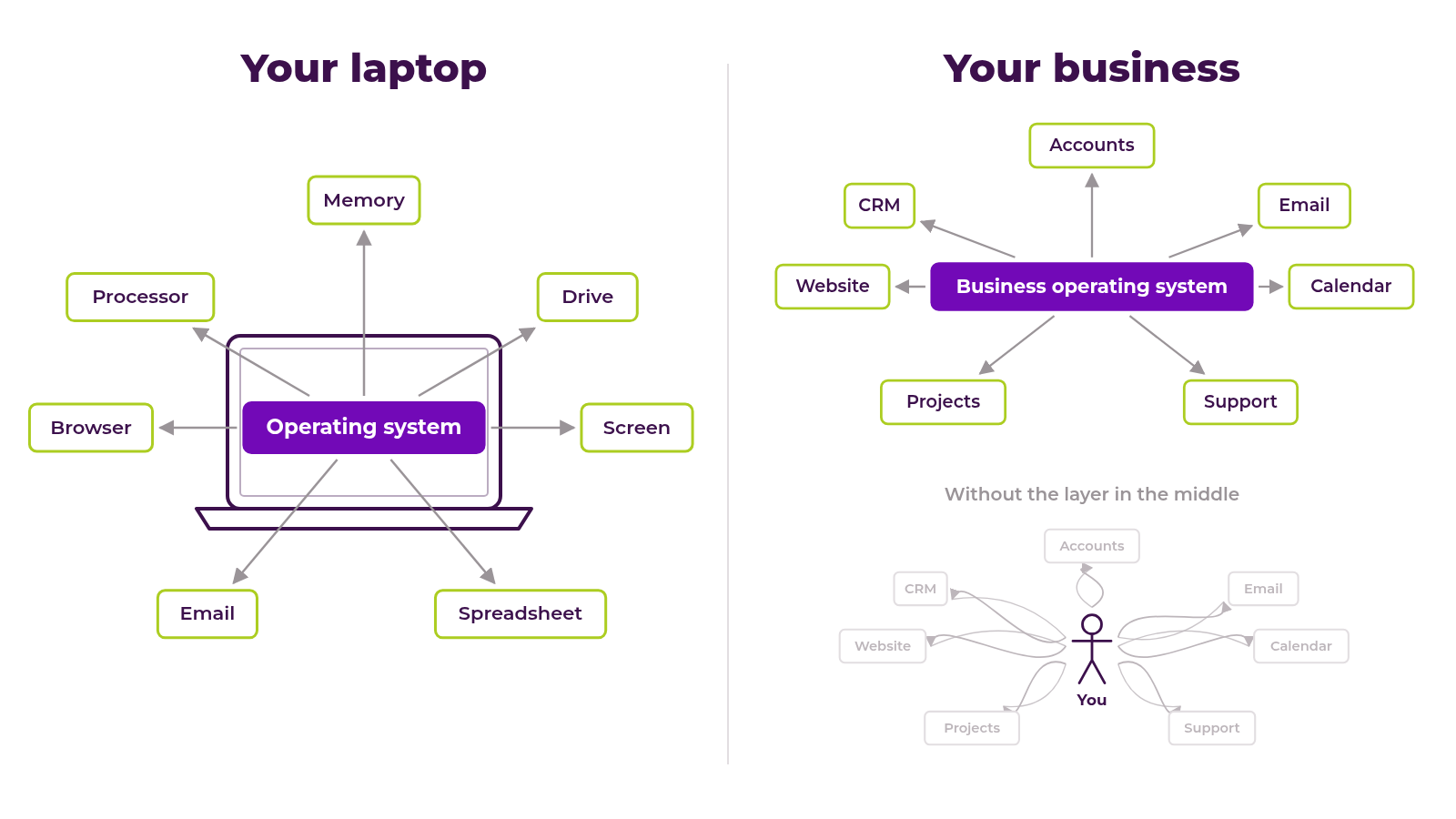
Think about the laptop you are reading this on. Inside it is a processor, memory, a hard drive, a screen, a keyboard, a wireless chip. On top sit a browser, an email client, a spreadsheet, a dozen other apps. You never think about any of that. You open the browser and it works.
The reason it works is the operating system. Windows or macOS sits between the hardware and the apps, managing the memory, sharing the processor, routing a file from the drive to the screen, letting the spreadsheet open the email attachment. Without it, the laptop is an expensive box of parts that cannot do anything together. With it, you forget the parts exist.
Now look at your business. You have the parts. A CRM, an accounts package, an email tool, a calendar, a project tracker, a website, a support inbox, a phone system. Each one works. What is missing is the layer in the middle that routes work between them so a thing that happens in one causes the right thing to happen in the next.
In most small businesses, that layer is the owner. You are the operating system. Every handoff goes through you.
Why does a CRM not count?
I meet so many business owners who tell me they have a system because they have a CRM. A CRM is one of the parts. It is the place where conversations and relationships live, and it is the most important part. But it is not the layer that connects the rest.
Here's what I mean. A quote is accepted in your CRM. What happens next? In a business without an operating system, someone notices, opens the accounts package, raises an invoice by hand, opens the project tracker, sets up the job, opens the calendar, books the kick-off, and sends a welcome email from their inbox. Five tools, five manual steps, one person remembering all of them.
In a business with an operating system, the quote being accepted is the trigger. The invoice raises itself. The job appears in the tracker. The kick-off goes into the calendar. The welcome email sends. The person who accepted the quote does nothing else, and nothing gets forgotten.
The CRM is where the trigger happened. The operating system is what carried it to the other four tools.
What happens when it is missing?
Marcus Sheridan, who wrote the foreword to my next book, put it plainly. Most owners he meets are paying for five tools, using 20% of each, and none of them talk to each other. That matches what I see. The cost is not just the subscriptions. It is the hours spent moving information by hand, the handoffs that get missed when the day goes sideways, and the owner who cannot step away because the business cannot route a job without them.
A client of mine, Mark, runs a freight forwarding business in London with a team of three. When I met him, revenue had sat at around £800,000 for three years. Not because he lacked leads or worked too little. He was working flat out and travelling the world building his network. The business simply could not move a lead from enquiry to follow-up to job without him in the chain.
We put the connections in. Leads were captured automatically and segmented by sector. Follow-up ran on its own. A monthly newsletter went to every contact in the system and brought back customers who had not used him in years. In his first year the business grew 40% to over £1.2 million. The tools were not much different from what he had before. What changed was that they were connected, and Mark was no longer the layer in the middle.
What are the parts of a business operating system?
The reality is that there are four, and most businesses have only the first.
- The tools themselves. The CRM, the accounts package, the project tracker, and the rest. You almost certainly have these.
- The connections between them. The links that let the accounts package know a quote was accepted, or let the CRM know an invoice was paid. Sometimes built in, sometimes through a connector tool, always the thing that stops information being retyped.
- The rules. When this happens, do that. Quote accepted, raise invoice. Deal lost, start the follow-up sequence. Customer silent for ninety days, create a task. These are the operating system's instructions, and they are what make the next action happen without a person.
- The data layer. One place where everything the tools know is gathered so the whole business can be seen at once. I cover this in the next post, and it is the part that lets AI do something useful.
Tools, connections, rules, data. Put those four together and your business stops relying on your memory. That is the whole idea.
Where do you start?
Not by buying anything. Be honest with yourself and map one handoff. Pick the thing that happens most often in your business, a new enquiry, an accepted quote, a finished job, and write down every tool it touches and every person who has to remember to do something along the way.
That list is the shape of your missing operating system. Most owners find four or five manual steps in a single handoff, and that one handoff happens dozens of times a month.
Then connect the two tools at either end of the most painful step. One connection, one rule. Let it run for a fortnight. Then do the next one.
In my own consultancy the whole business now runs on one connected suite, and the honest reason is that connecting a dozen separate tools got harder than running them in one place. That is a decision for later. The first decision is simply to stop being the operating system yourself.
If you want to see how connected your business is today, the Clarity Scorecard takes five minutes and shows you where the handoffs are breaking.