Automate first. Add AI only where judgement is needed
Most of what eats your week never needed AI. It needed a rule. Automate first, then add AI where a decision has to be made.

Richard Mawer
Founder, Leadnamic Systems Ltd
You have been told AI will save you hours a week. You have signed up for a tool, maybe two. And the same jobs are still eating your Tuesday, because nobody told you that most of them never needed AI in the first place. They needed a rule.
Here is the distinction that matters. Automation is when this happens, do that. No thinking required. AI is look at this, work out what it means, then decide. Reasoning required. Most of what fills a small business owner's week is the first kind, and putting AI on a job that only needed a rule makes it slower, dearer, and less reliable.
So the order is automate first. Then add AI where a decision has to be made. That order is the whole of this post.
What is the difference between automation and AI?
Think about this for a moment. A website enquiry comes in. What should happen? The details should land in your CRM. An acknowledgement should go to the person who enquired. Someone on your team should get a task with a deadline. If the task is not done in a day, a reminder should fire.
Not one of those steps needs a decision. Every one of them is a rule. When a form is submitted, do these four things. That is automation, and it has been inside business software for thirty years. It is not clever. It is reliable, which is better.
Now a different job. Fifty enquiries came in last month. Which five should you call first? That needs someone to read each one, weigh what they asked for against what you do well, and rank them. That is judgement. That is where AI earns its place.
The mistake I see most often is reaching for the second tool to do the first job. An AI agent asked to acknowledge a contact form is a sledgehammer on a drawing pin. It costs more, it occasionally does something odd, and it needs checking. A rule does it the same way every time for nothing.
What should you automate first?
I meet so many business owners who want to start with the exciting thing, and the exciting thing is always AI. The reality is that the biggest wins are the dull ones.
A manufacturing client of mine, over twenty years old and past £3 million in revenue, had a member of staff who downloaded a PDF invoice from their operations software and typed it, line by line, into their accounts package. She told me she spent six hours a day doing it. Six hours. Every day. Nobody had noticed because it had always been done that way.
We broke the job into its steps and connected the two pieces of software. No AI was involved. The invoice now moves on its own, and six hours a day of a person's working life came back to the business.
That is what automation looks like when it is done properly. It is rarely glamorous. Here is what I look for first in any business.
The same email being sent over and over. Acknowledgements, confirmations, reminders, chasers. If you could write it as a template, a rule can send it.
Information being copied from one place to another. Invoices retyped. Contacts entered twice. Spreadsheets updated from another spreadsheet. Every one of these is a connection waiting to be made.
Follow-ups that depend on someone remembering. The quote sent and never chased. The deal lost and never contacted again. In my own agency, one rule that put every lost deal into a follow-up sequence brought back around 20% of them. Worth over £100,000 a year, and nobody had to remember to do it.
Handoffs between people. Job finished, invoice raised. Quote accepted, project created. Each one a trigger and an action.
If I was sat opposite you right now, I would ask you to name three jobs in your business that fit one of those four patterns. You will have them within a minute. Those are where you start.
Where does AI actually belong?
Once the rules are running, AI becomes useful, because it can sit on top of a system that already moves and add the judgement the rules cannot.
Reading and ranking. Which of these fifty enquiries is the best fit? Which of these support tickets is angry? Which of these proposals went quiet for a reason you should care about?
Summarising and drafting. Turn this call recording into notes and next steps. Draft a reply to this complaint in our tone. Write the first version of this proposal from the discovery notes.
Spotting what a person would miss. I wrote about this in the data layer post. Once your data is in one place, AI can see that the customers who left last year all raised three support tickets first, and that five current customers fit the same pattern today.
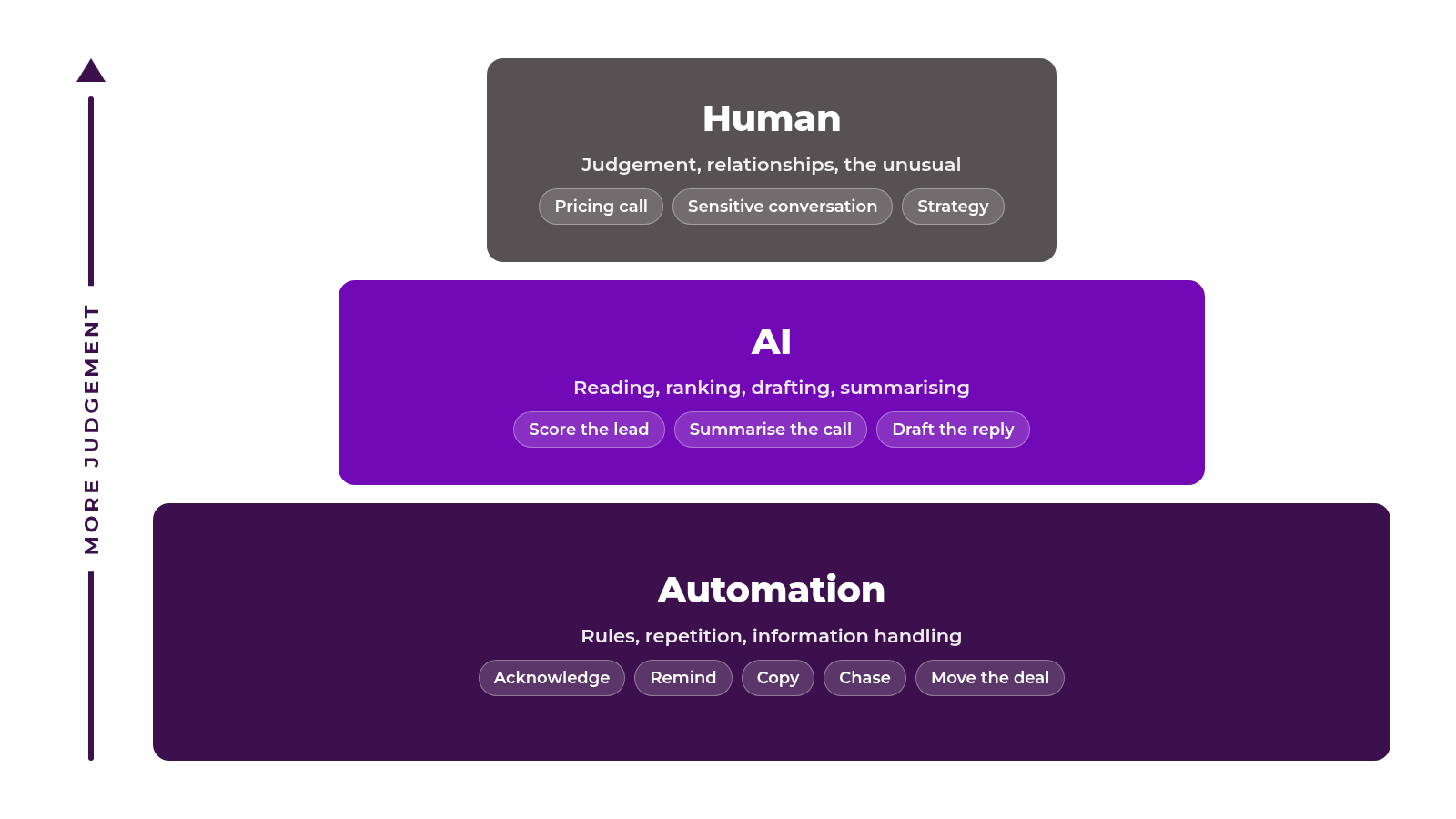
In a client test last year we automated around 80% of a sales process. Nearly all of that was rules. Capture, acknowledge, task, remind, move the deal, chase the quote. AI came in for the small remainder: scoring the leads, drafting the first follow-up, summarising the calls. The rules did the volume. AI did the thinking. A human did the conversations that mattered.
That split, roughly, is what I would expect in most businesses. Most of the gain is automation. A smaller share is AI. The rest stays human because it should.
How do you decide which is which?
Here's a test I use with every client. Take any task and ask one question. Could you write the instructions for it on a card and hand them to a new starter, with no judgement calls left to them?
If yes, it is a rule. Automate it.
If the card would have to say "use your judgement" at some point, that is where AI or a person comes in. Then ask whether the judgement is one a well-briefed assistant could make, or one that needs you. The first is AI. The second stays with you.
Sensitive conversations, pricing calls, strategy, and anything unusual stay human. Everything rule-based, repetitive, or information-handling goes to automation. The narrow band in the middle, reading, ranking, drafting, summarising, is AI's.
One warning. Never automate a broken process. A rule that fires on a bad process just produces the wrong result faster and more often. Map it, simplify it, then automate it. In that order.
What should you do this week?
Be honest with yourself. Pick one task that fits one of the four patterns above. Write down what triggers it and what the finished result looks like. Then connect the tool where it starts to the tool where it ends with one rule.
Let it run for a fortnight. Count the time it gave back. Then do the next one.
Leave AI for the third or fourth task, once the rules are carrying the volume. By then you will know exactly where the judgement calls are, because they will be the only things left on your desk.
If you want to see where the biggest automation wins are across your business, the Clarity Scorecard takes five minutes and shows you where time is going that a rule could take back.