Can I put customer data into ChatGPT? The rule every small business needs
If you would not put it in an email to a stranger, do not put it into AI. The three lists and the one-page policy that keep your business on the right side of UK GDPR.

Richard Mawer
Founder, Leadnamic Systems Ltd
Someone on your team pasted a client email into an AI tool this week to draft a reply. Maybe it was you. It saved ten minutes and nobody thought twice. The question is whether it should have happened, and the honest answer is: it depends entirely on what was in the email.
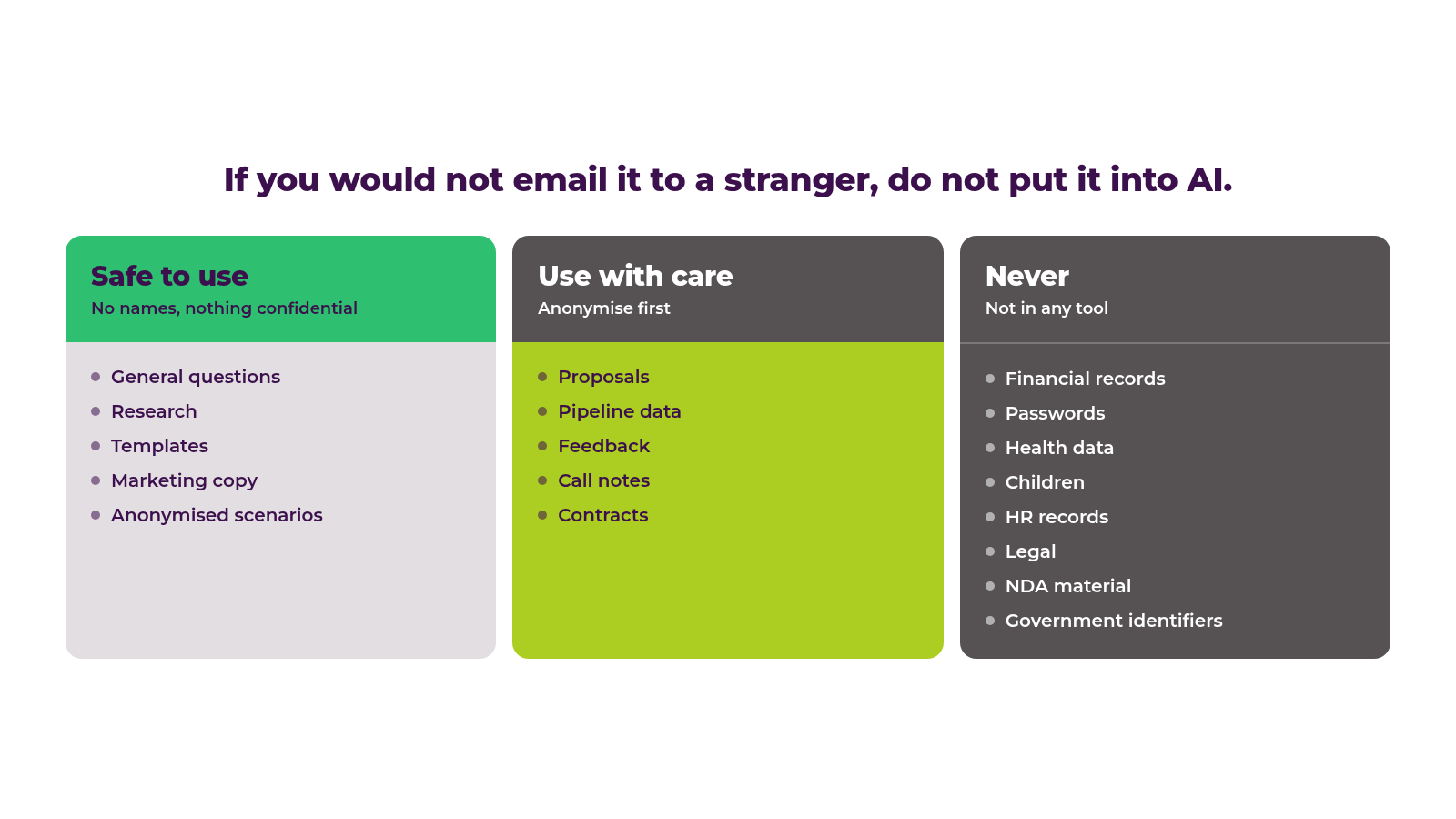
Here is the rule. If you would not put it in an email to a stranger, do not put it into AI. That one sentence covers most of what a small business needs to know, and if you take nothing else from this post, take that.
The rest is about why the rule exists, what it means in practice, and the ten minutes of work that puts you back in control.
Why does it matter what I paste in?
Every time you or a member of your team pastes something into an AI tool, you are processing data. That is the sentence most owners miss. Under UK GDPR, feeding a person's details into any system, including an AI tool, is processing their personal data, and the same rules apply as for any other system you use.
The ICO sets out seven data protection principles, and three of them bear directly on AI.
- You need a lawful reason to process the data. The fact that a tool is convenient is not one.
- You should only use the data you need. Pasting an entire client file to draft a two-line reply is more than you need.
- You are responsible for accuracy. AI tools make things up, confidently. If one invents a detail about a customer and it reaches that customer, the liability is yours, not the tool's.
None of this makes AI unusable. It makes it like every other tool that touches customer data: fine when used with a little care, a problem when used without any.
The reality is that the risk is rarely the tool. It is unstructured human behaviour around the tool. I remember GDPR arriving in 2018 and the panic in small businesses that had no idea what they could and could not do with the data they held. AI is producing the same confusion now. The difference is that this time you do not need a legal team to get it right. You need one rule, three lists, and a one-page policy.
What is safe to put into AI?
Think of it as three lists. Green, amber, red.
The green list is anything with no names, no identifiers, and nothing confidential. General business questions. Industry research. Drafting a template or a standard procedure. Marketing copy. Meeting agendas, job descriptions, training material. A scenario described without identifying anyone, such as "a client in professional services asked us about this". If the text appeared somewhere public it would not matter. Use AI freely here.
The amber list is anything that contains identifying or sensitive information but can be used safely if handled with care. Client proposals, once the name and the figures are replaced. Sales pipeline data, inside a secured business AI account rather than a free personal one. Customer feedback with the identifiers stripped. Meeting notes and call transcripts with names and sensitive details removed. Contracts for structural review, anonymised first. The habit that makes amber safe is simple: anonymise before you paste.
The red list is anything that would be a serious breach if it were exposed, used to train a model, or seen by a third party. Full financial records, bank details, account numbers. Passwords and system credentials. Medical or health information about an individual. Anything about children. HR records with names attached. Legal correspondence. Anything under a non-disclosure agreement or that a third party has told you is confidential. National Insurance numbers, passport details, any government-issued identifier. Never. Not in any tool, however secure.
Be honest with yourself. Think about the last five things pasted into an AI tool in your business. Which list was each one on?
What is shadow AI and why should I care?
Shadow AI is any AI tool someone in your business is using that you have not approved and may not know about. It is rarely sinister. Somebody in marketing found a tool that makes their job easier and started using it. The problem is that you have no idea what list they are pasting from.
There is a sharper version. A shadow agent is not a tool that drafts something for a person to check. It is an AI set up by a team member to take actions on its own, sending emails, updating records, moving data, without anyone reviewing it. That is a different level of exposure, and it can exist in your business today without you having been told.
The answer to both is not a ban. Bans push the behaviour further into the shadows. The answer is to make the rules clear and the approved tools easy to use, so there is no reason to go round them.
What should a small business AI policy say?
One page. Five parts. Ten minutes to write if you use the structure below, and better if your team helps shape it, because a policy people had a hand in is a policy people follow.
- Purpose. Why the business uses AI and what it is for.
- Allowed uses. The green list, and the approved tools for it.
- Restricted uses. The amber list, who may use it, and the anonymise-first rule.
- Prohibited uses. The red list. No exceptions.
- Review. Every three months, because the tools change, new risks appear, and your own examples will teach you more than any guidance.
Alongside the policy, keep a simple register of any AI agents running in the business: what each one is called, what it does, what it can access, who owns it, and when it was last checked. One row per agent. If you ever have to answer the question "what AI is running in my business right now?", that register is where you look.
This is not legal advice, and if your business handles sensitive data at scale, get some. But for most small businesses, the rule, the three lists, and the one-page policy are the difference between AI being a risk and AI being a tool.
What should you do this week?
Share the stranger rule with your team today. One sentence, in whatever channel they read.
Then ask each of them which AI tools they are using for work. Not as an audit, as a conversation. You will learn what is already happening, and that is the starting point for the policy.
Then write the one page. Purpose, green, amber, red, review. Put it where the team can see it and put the review date in the diary.
If you want to see where AI, data, and systems sit across your whole business, the Clarity Scorecard takes five minutes and shows you where the gaps are.